
Issa Kabeer and Jayson Massey
December 8, 2023
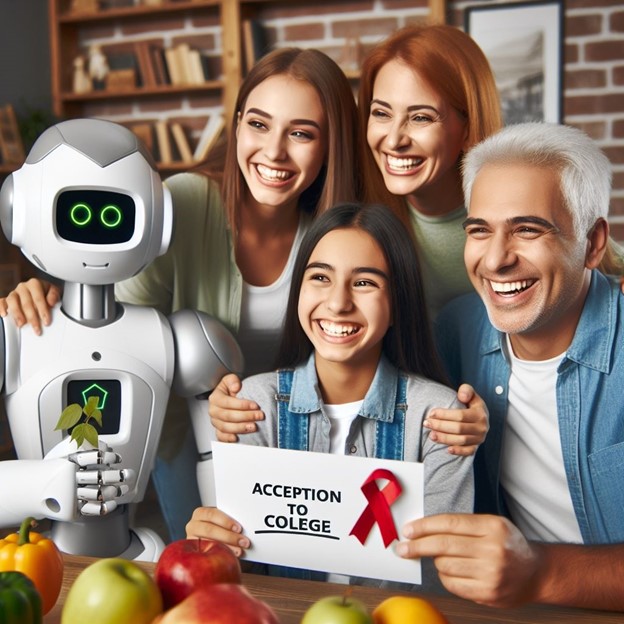
As some of our pride prepares for admission to their future four-year university, some applications may never meet a pair of human eyes. The world we live in is something many imagined in the realm of science fiction decades ago. In our globalized, technological world Artificial intelligence (AI) has appeared at the forefront of machine simulation of human intelligence, with overarching goals of computer-enhanced learning, reasoning, and perception. Socially, AI is characterized by concerns for its growing potential; naturally, humans are weary at the sudden development of highly intelligent technological forms. The recent and drastic development of AI has borne tools that admissions officers within academia. However, when we consider the influence existing, non-intelligent technology has on academic integrity among students, how do we address the growing presence of AI in the academic space? Schools are sanctuaries for growing minds. We must ask ourselves; does the presence of AI in the academic space pose ethical concerns?
Technology changes over time. Humans lived comfortably before the computer, even feared the computer, and now, humans rely on the computer. With every new major technological advancement comes human acclimation; as we develop technology, technology develops us. We are watching this acclimation manifest in the creation of new industry, with OpenAI becoming the prototypical figure of AI and research development. The company is a non-profit private research laboratory aiming to direct AI in ways that benefit humanity as a whole. OpenAI is effective in thought, with innovations of tools for people with disabilities, language learning processes, automated aircrafts and automobiles, and offering several types of virtual assistance. Another positive in the integration of Open AI is affordability. When considering alternatives to OpenAI, access to its resources are limited. Grammarly AI, for example, allows users one hundred AI-generated prompts, but requires a premium account for anything more than one hundred.
Tech and innovation journalist Lauren Coffey explores the potential positives of AI’s use in college admissions offices: “AI tools help admissions officers identify seven key traits in essays, including teamwork, perseverance, intrinsic motivation, and willingness to help others.” The ‘fear of the unknown’ attitude permeating the development of AI may not be the best way view of this innovative technology. This fear may be pushing us away from reaching the full potential of what positives AI has to offer the world.
At CCP, many students will be looking to transfer to other colleges and universities, like the 230,000 students have in 2022, per The National Student Clearinghouse. They may assume that an employee from the admissions office will review their application and transcript; however, we dawn upon a new future and universities are now utilizing Artificial Intelligence (AI). How are they using it? Is it safe? And is AI the one admitting new students now?
One school is already moving forward with AI-powered applications: Maryville University, a small private college in Town and Country, Missouri. With 6,500 online enrollees, the university has a contract to use a tool called Sia created by the firm OneOrigin that examines transfer applicants’ transcripts.
According to OneOrigin, Sia reads high school and college transcripts, eliminating the manual processes for admissions personnel, and presents the information the admissions department needs. The firm claims that it “is trying to help admissions officers spend more time making decisions and is not trying to make the decisions about whether to admit a given applicant.” Sia may prove to be an unbiased alternative to the understaffed admissions officers that may overlook or turn down potentially prime candidates.
AI is expected to oversee even more of the student application process in the coming years. Researchers from the University of Colorado at Boulder and the University of Pennsylvania created still more AI tools that evaluate seven essential attributes in application essays. The researchers fed the AI over 300,000 applications and essays and used admissions officers to further train the tools. Part of the project is to address admissions biases. Benjamin Lira, a co-author of the study, said “you’re not going to read the first essay of the day in the same [way] you read the last one before lunch.” Lira feels that AI can be a part of an admissions process “which looks at applicants as a whole and not just their grades or test scores.”
Colleges are moving to automate the admissions process. In fact, admissions departments are using AI to review recommendation letters and personal essays. AI chat bots conduct, transcribe, and analyze candidate interviews.
A serious concern with the current AI model is the lack of transparency. Forbes states that about twenty percent of ChatGPT responses could include incorrect information. Avoiding this fate requires transparent sources for training the AI and supplying fully referenced links to original sources for validity checking.
Another downside is the misinterpretation of AI data. In the AI application essay study, “if a student were to say they donated heroin to the children’s shelter, it brought a very high score in the ‘prosocial purpose’ category.” Giving illegal drugs to kids is not a positive social purpose. AI does not recognize this.
AI tools may also repeat historical bias around wealthy white applicants by mimicking previous patterns of student acceptance. This critique moved the University of Texas at Austin’s computer science Ph.D. program in 2020 to cease its AI admissions program.
Shockingly, Intelligent Magazine reports that over 80 percent of admissions officers said the final decision of the student admissions process rests upon AI.
With AI doing this work for understaffed and overworked admissions staff, what do you do if a college rejects your application? U.S. News and World Report recommends accepting an offer from a different college or university, especially since the appeals success rate is estimated to be only three to eight percent. If there are mistakes on the initial application: incorrect scores; inaccurate grades; or sizable news, such as a life change or a new achievement, prospective students can send an appeal. If that does not work, Scholarship 360 says to try multiple times, as many schools take applications at various times of the academic year.
Overall, it is important to consider the power of OpenAI within college courses as well as the admissions process. AI offers tools at an affordable price tag and can help offer students aid in collecting their ideas to help support writing their thoughts in schoolwork. To supplement your learning and recreational enjoyment, use all forms of AI and do not hastily fear new developments.
Edited by Allison Miller
December 15, 2023

