
Soil toxicity in and around the Community College of Philadelphia
by E. L. K. Noszka
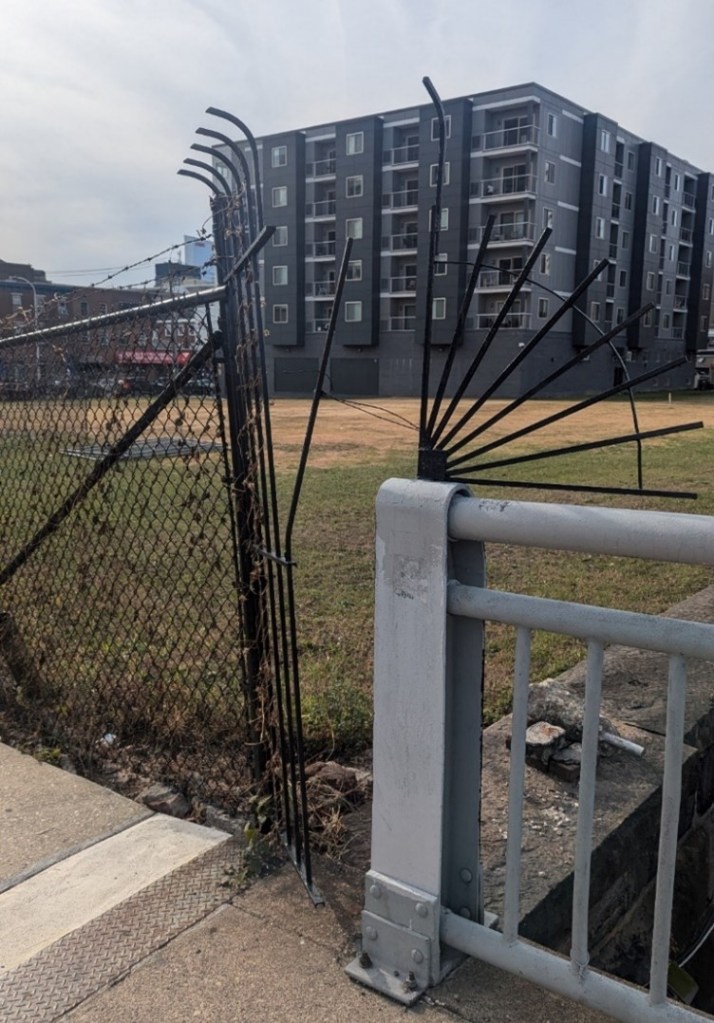
On the northwest corner of 18th and Callowhill St. sits a field of sunburnt yet manicured grass, easily overlooked by passersby. Even those of us who come and go daily from the CBI building across the street may fail to notice such unremarkable emptiness.
The lot could be easily mistaken for the lawn of the recently-built apartment building next door; but a closer look reveals a more complicated truth. Around the grass, a barbed wire fence restricts entry. A rusty iron gate, hanging open over the railroad cut, provides a narrow passage for the determined trespasser. Chicken-wire marks off a private parking lot in the southeast corner, where weeds and shrubs sprout amongst the gravel. Such a property seems primed for real estate development—and so thought Michael Karp, when he purchased the lot in 1997 for $700 thousand. The land had been vacant since June 1980 when Polychlorinated biphenyls (PCB) were discovered on-site, according to documents released by the Environmental Protection Agency (EPA).
PCBs are highly toxic chemicals used in various products of the mid-20th century. According to the Centers for Disease Control and Prevention, in addition to being a carcinogen, causing especially liver cancers and melanoma, exposure to PCB compromises the immune system, central nervous system, hormones, reproductive health, and more. Poisoning occurs through dust, fumes, and direct skin contact. When PCB gets into the ground, soil erosion and run-off can spread the toxin to surrounding areas and nearby bodies of water, including public water supplies.
Human health effects became widespread after PCBs were first manufactured in 1954. Despite mounting evidence of toxicity, the Monsanto Company, the only manufacturer of PCB in the U.S., continued to distribute the toxin via paint, cement, tar, carbonless copy paper, and power transformers, until federal regulations banned the chemical in 1978. As an oil, PCB acts as a coolant and, at 18th and Callowhill, was used in the manufacture of electrical power transformers—the kind you see atop telephone poles and along railroad lines.
After the discovery of PCB at 18th and Callowhill, three clean-ups were conducted between 1980 and 1984. The transformer plant responsible for the contamination was demolished in 1981 and soil was removed from the site. Yet a 1989 survey conducted by Environmental Resource Management (ERM) tested at 50 parts per million (ppm), well above the EPA-approved maximum. Some soil samples tested as high as 292 ppm.
Plans were developed at this time by the landowners Asea Brown Boveri, Inc. and the Franklin Town Corporation to pave the site into a parking lot, as recommended by the EPA. An asphalt cover of five layers—an 8-inch stone base, 1-inch gravel, tack coat, a moisture barrier, and 3-inches of asphalt-cement—would protect from surface contamination. However, even these precautions might not be adequate. In an e-mail dated March 1997, the same year Michael Karp’s company Callowhill Associates LP purchased the property, an EPA employee named John E. Kelly expressed doubts to his coworker Bob Guarni:
“You already heard my ‘public health’ opinion if the contaminated soil is covered over with asphalt and or cement. Of course, if you leave 130 ppm PCBs in the soil and cover it over, I think it should require some type of notice to prospective future buyers or a deed restriction (don’t want someone removing the cement/asphalt in the year 2050 and turning this into a playground unaware of the PCB contamination).”
Unfortunately, Mr. Kelly’s foresight was not far off. Although the parking lot was never built, in 2022 an apartment building was constructed on the western portion of the lot by University City Housing, Michael Karp’s land-leasing firm and a parent company of Callowhill Associates LP. The building is advertised as “The Baldwin luxury apartments,” a reference to Matthias Baldwin Park, located just across the railroad cut, which also has a history with PCBs. Like the site at 18th and Callowhill, what was once a Baldwin Locomotive Works building became an electronics manufacturer—in this case, the I-T-E Circuit Breaker Company—which also used transformers containing PCB oil, according to the non-profit Friends of Baldwin Park.
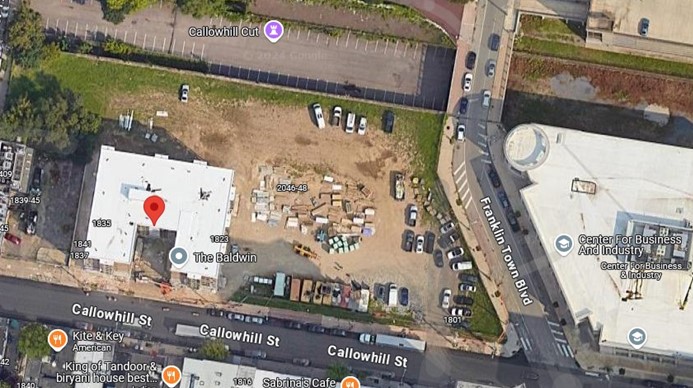
(Captured June 6, 2022, via Google)
On June 6th, 2022, Google Earth captured a satellite image during construction of The Baldwin luxury apartments (see above). According to a report produced by NUS (National Utility Service) Corporation in 1989, safety guidelines for this site include contamination avoidance: “Never sit down or kneel, never lay equipment on the ground, avoid obvious sources of contamination such as puddles, and avoid unnecessary contact with on-site objects.” We can see clearly in the satellite image that the construction team took no such precautions. Building materials lie directly in the dirt of the contamination zone, puddles nearby. Aside from a throw of gravel in the southeast entrance, far from the 5-layer barrier which the EPA suggested, no measures appear to be in place to control dust-borne contamination.
The assessed value of the property is $13.6 million, according to county records, and currently owes $130 thousand in back taxes for the years 2023 and 2024. A 2-bedroom, 2-bath apartment at The Baldwin goes for $3,715 per month. Would the building’s residents reconsider such a luxurious price if they knew what carcinogens lie within their soil?
Given the neighborhood’s industrial history, locals should be unsurprised if even more biohazards lurk nearby. Baldwin Locomotive Works maintained a large complex in the area for almost a century, replaced in the 20th century by smaller factories such as the electrical manufacturers responsible for the PCB contamination. In the 1970s and ‘80s, hundreds of row-homes and industrial buildings were demolished by order of the City, to make room for a development project which was never realized. The newly-demolished blocks, however, allowed the Community College of Philadelphia, with its new headquarters in the Mint Building, to expand south and westward.
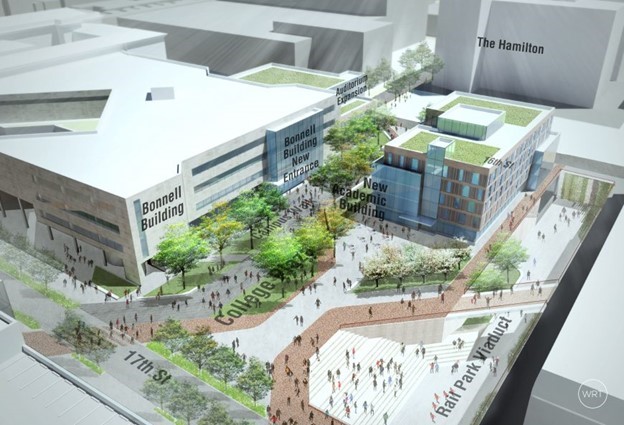
And the College has expanded even further in recent years, with two new campuses in Northeast and West Philadelphia. In 2017, the College planned new construction in place of a faculty parking lot south of the Bonnell Building. Designs by the architecture firm Wallace, Roberts, & Todd LLC (shown above) included a plaza, a Health and Sciences Building, and a “Rail Park Viaduct,” which would transform the railroad cut into a pedestrian thoroughfare. Despite winning the SCUP Excellence in Planning Award of 2017, these plans, for untold reasons, never broke ground.
The faculty parking lot remains, flanked to the east by doublewide trailers and to the north by Grady’s Community Garden. The garden, founded in 2018, grows fresh produce which is distributed through the College’s food pantry, known as the “Snack Rack.” When asked if the garden or the adjacent land had ever been tested for soil toxins, CCP’s Coordinator of Student Life Jenavia Weaver assured that all produce was grown in raised beds with organic soil. Raised beds, however, do not protect from soil toxins. While Grady’s Community Garden may not contain anything as carcinogenic as PCB, the industrial history of the neighborhood alone warrants, at the very least, a test for the presence of lead, the most widespread toxin in Philadelphia.
Until then, as Ms. Weaver states, “We don’t know what’s in the soil.”
_______________________________________________________________________________
Representatives of University City Housing claimed not to manage any property on the 1800 block of Callowhill Street. Calls and e-mails to Oren Brothers Real Estate, the management company listed on The Baldwin’s website, went unanswered. The Community College of Philadelphia has yet to release information about why the 2017 development plans for the Main Campus were never actualized. According to Jenavia Weaver, the spring project for Grady’s Community Garden will be “to assemble new garden tables.”

