
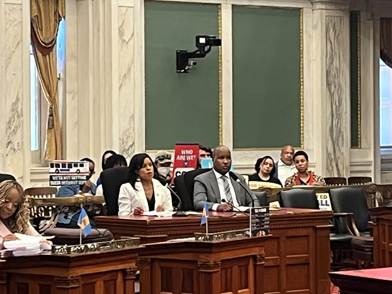
CCP President Dr. Alycia Marshall addresses City Council, with students, faculty and staff holding signs in support of the SEPTA pass program. Photo: Julia Gokalp
By Julia Gokalp
On June 11, the Philadelphia City Council approved the final operating and capital budgets for fiscal year 2027, which includes an additional $1.6 million annually for CCP’s operating support, according to a press release from the city government website.
This comes after CCP administrators testified at a city council budget hearing on May 5, highlighting programs, outlining goals, and requesting funding for the upcoming year.
“The Community College of Philadelphia is really an economic engine of mobility for the city, and we can’t do that without your support, so we appreciate that,” CCP President Dr. Alycia Marshall said.
During these hearings, councilmembers question agency representatives in advance of the final city budget decisions.
Marshall characterized the college as a bastion of economic mobility. She gave an overview of workforce training programs and shared the story of Donvail Wilson, a former barber who graduated as valedictorian from the new naval welding program at CCP’s Career and Advanced Technology Center.
She also highlighted the establishment of partnerships, the opening of new facilities, the graduation of 1,968 students – including 122 dual-enrolled high school students – and recognition received from several national institutions.
Marshall cited an economic impact report (not yet released to the public) from Econsult Solutions explaining the college’s return on investment for students, for Philadelphians, and for Pennsylvania. She shared the finding that CCP generated $1 billion in annual economic activity in the state, $882 million of which was in Philadelphia alone, including $30 million in tax revenues.
She also thanked City Council for the city’s investment in the Octavius Catto Scholarship, which provides full tuition, stipends, and support services to eligible students.
Marshall called on Daniel Emdin – 2026 graduate and Student Government Association president — to share his story.
“Like many students in the city of Philadelphia, I saw college as something that was out of reach: too expensive, too uncertain, and simply not built for people like me,” Emdin said. Then his brother encouraged him to apply for the scholarship.
Thanks to the support and the mentorship he found at CCP, Emdin saw a path forward as a “physician policymaker.” He graduated with a 4.0 GPA and received the Cooke Undergraduate Transfer Scholarship, which covers up to $55,000 per year at a four-year institution.
“None of that started at an elite institution,” Emdin said. “It started right here at the Community College of Philadelphia. That is the impact of CCP – it takes students who may not see a future for themselves and equips them with the tools, confidence, and support to succeed at the highest levels.”
City Council Q&A
During the subsequent Q&A, councilmembers raised questions about the upcoming 9.4 percent tuition increase coming this fall, which was attributed in part to flat state funding and rising expenses.
“We had not raised tuition in nine years,” said Shannon Rooney, Vice President of Enrollment Management and Strategic Communications, in a previous interview. “It was not something that we wanted to do, but given the expanding costs of every single thing we do at the college – not just the contract, but all of the materials we use, all of our benefits that we give to employees, the cost of every part of our business is going up.”
City Council also raised questions regarding the progress of programs, infrastructure maintenance, and the prospective SEPTA UPass program.
The administration and the faculty and staff union signed a memorandum of understanding last spring, averting a strike. The memorandum states, “The parties agree that during the term of this agreement the College will negotiate with SEPTA for a free public transportation benefit.”
The interpretation of that memorandum — whether it implied that the college would acquire free SEPTA passes for the student body or would merely negotiate for them — was a point of contention.
“I’m very concerned about promises made, promises being kept,” Councilmember Jim Harrity said.
Other councilmembers shared that concern. Harrity said that the memo was signed in good faith with the expectation that a deal with SEPTA would be reached. The passes, he argued, are also a wraparound service that would help with student retention and graduation.
Marshall highlighted the prospective financial difficulty of using SEPTA’s usual UPass program at CCP: “If we start offering SEPTA passes — which I think would be great — we are signing up to [$2.1 million] or more as our enrollment increases, and every year, we would need to figure out how to fund that.”
General Counsel Carolyn Flynn explained that, in addition to the cost of the program itself, a new human resources position might be needed to track student eligibility each month.
Marshall added that CCP recently requested funding for the UPass program from the state. In the meantime, budget assessments and data analysis from the survey and from the pilot program are ongoing.
Councilmember Rue Landau shared that in a recent town hall, a student from South Philadelphia mentioned being unable to afford the transportation costs to get to class. She said that City Council would try to help with funding and reiterated the importance of the program:
“I know you want this too, so we’re all on the same page. We can all work collectively to make this happen, but this would be the success story for the region, maybe even the country. Who knows?” Landau said.

