
Photo: Julia Gokalp
By Julia Gokalp
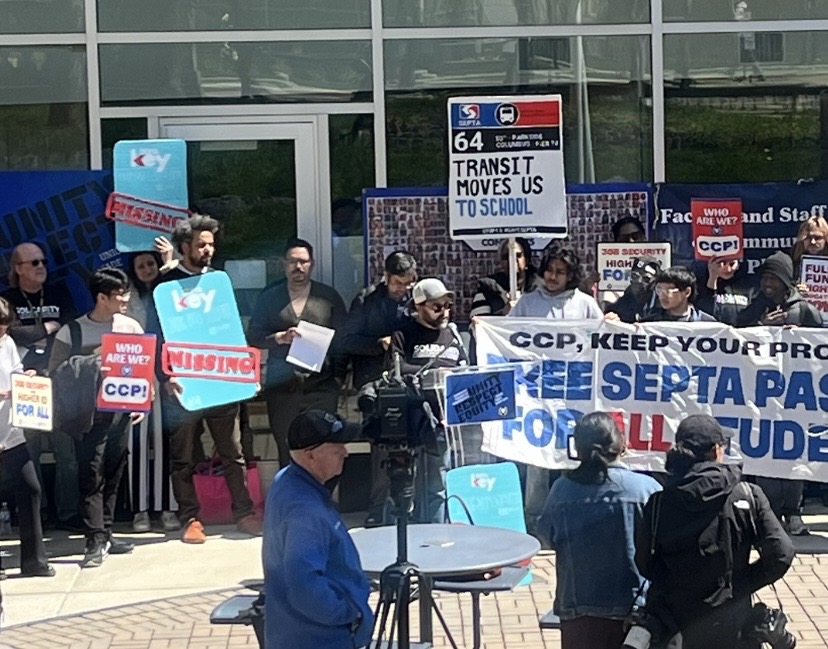
On the sunny afternoon of Thursday, April 9th, a group of students, faculty, and staff stood in an arc at the front of Bonnell Courtyard, chanting slogans in favor of reforms — namely, for the provision of free public transit passes for students here at CCP. Several demonstrators held signs including enlarged replicas of SEPTA key cards – emblazoned with red labels that read, “MISSING.”
The rally marked just over one year since the faculty and staff union, AFT Local 2026, reached a contract agreement with CCP’s administration after over 14 months of negotiations, averting a strike. The union’s Treasurer, English professor Jamie Zigarelli, highlighted several provisions of last year’s negotiations including staffing and pay increases, paid parental leave, and smaller class sizes.
He also mentioned two other negotiated items: on-campus childcare and free SEPTA passes for students. These were part of a memorandum of understanding signed between the administration and the union on the morning of the strike deadline. Regarding the transit passes, it states: “The parties agree that during the term of this agreement the College will negotiate with SEPTA for a free public transportation benefit.”
He explained that the last two commitments, negotiated mere hours before the strike deadline, have not been implemented. He expressed disappointment with the pace of progress.
“It’s been a year. We need real options, a real timeline, and a real plan,” Zigarelli said.
He added that although a pilot program had been implemented for free transit passes, it only applied to “a handful of students” at the West Philadelphia campus.
“[The college] agreed to continue the conversation, to negotiate with SEPTA for some eventual, potential free transit,” Shannon Rooney, Vice President of Enrollment Management and Strategic Communications, explained in an interview, referring to the memo, “but we did not agree to provide free transit.”
Through SEPTA’s UPass program, once CCP identified what group of students would be eligible for monthly passes (full-time students, part-time students, etc.), the college could acquire passes for that entire population at a discounted rate. The sticking point, Rooney clarified, is that there is no means for individual students to opt in or out.
“Once we identify the population, we are under contract to pay for every student who’s eligible within that population, regardless of whether they use it or not,”– even if some students turned down the monthly pass offer outright.
The administrative load for updating students’ eligibility week to week, Rooney admits, would be significant, and she estimates that providing passes to all students would cost approximately $2.2 million per year.
She explained that discussions with the Student Government Association and with SEPTA are ongoing, and the college is exploring alternatives to the UPass program.
Several faculty, staff, and student speakers followedafter Zigarelli’s remarks. Some speakers, including physics professor Gabriel Carryon, reiterated the importance of childcare and transit passes.
“I’ve had countless experiences with students who have had to skip class because they couldn’t secure childcare for their kids. No student should have to make this choice,” Carryon said.
Ciarán DiMartino, 2nd Vice President of the SGA, spoke from personal experience:
“As a Catto scholar… from a low-income family, a free SEPTA pass would resolve my remaining financial burden that comes with attending college,” DiMartino said.
Others spoke about funding-related matters. Among them were rising tuition: the Board of Trustees voted to raise tuition 9.4% in the fall semester. City and state funding, one of the speakers mentioned, has not kept pace with the cost of living.
Some speakers mentioned broader advocacy, referencing an upcoming “Workers Over Billionaires” rally in May (flyers were passed out at the press conference).
Another concern was high classroom temperatures resulting from HVAC issues. Ariel Vazquez, Assistant Professor of Architecture, Design, and Construction, noted that the high temperatures – allegedly up to 90 degrees — distracted his students. He attributed these high temperatures to “deferred maintenance and years of chronic underfunding from the city and state.”
In celebration of past achievements from last year’s negotiations and with hope for the future, librarian Noelle Egan said, “The Community College of Philadelphia is only as successful as our entire community. We will keep fighting for full funding from the city and state, SEPTA passes for all our students, and for a culture of respect for our workers.”

